If you’ve driven by Tinhorn Farm on Route 144, you might have wondered why someone would choose to raise pigs. RCS Community Business Association talked with David-John Stacey, the farm’s owner, to find out. Here’s what he had to say.
How did you start raising pigs?
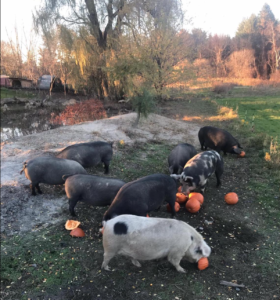 I had already raised the “gateway” farm animals – chickens. I became interested in other livestock and decided to start with pigs. I started looking into raising pigs and locally for available pigs (for about two years). I found an add in Want Ad digest from a farm in Berkshire County with piglets and drove over and bought two (Benny and Mama pig).
You raise pastured pigs. What does that mean?
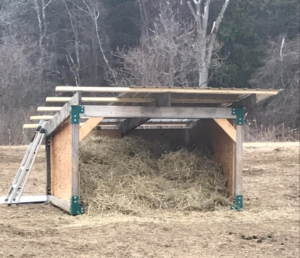 Pastured pigs are pigs that spend most of their life outdoors but have shelter for when they need it. They can be outside as much or as often as they want. The pigs supplement their feed (locally milled grains and vitamins formulated for pigs) with grass, flowers, weeds, clover, worms, bugs, frogs, ground bird eggs – whatever they forage from the fields. We have about six acres of pasture that is surrounded by electric fence. I chose this type of management because I wanted the pigs to have space, be able to go outdoors and do “pig things.” This produces a stronger, healthier, and calmer animal. Pigs specifically need to root (dig, move the earth with their face), and they’re much happier when that’s possible.
Do you raise any particular breed(s)?
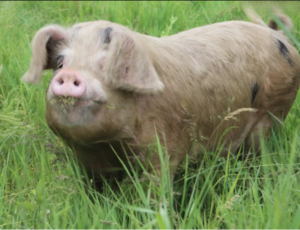
I raise Gloucester Old Spots and Large Black varieties of pigs. These are both heritage breeds of pig. Both are particularly suited for pasture. Historically, Old Spots were orchard pigs, used to clean up under and around fruit trees. Both are large, domesticated breeds of pig. They’re friendly animals, easy to handle, calm, personable, and excellent mothers.
Who do you market to?
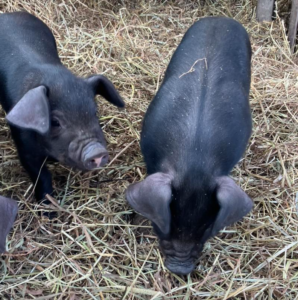
I mainly market to other farms. These farms may be looking for breeding stock. Many farms are also looking for piglets to raise and don’t want to keep full grown sows and a boar (they’re VERY big). It’s also expensive to keep breeding pairs.
How many mama pigs and boars do you keep?
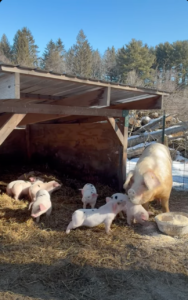 I usually have around a dozen breeding sows – with a few being cycled in (raised to full grown) and a few cycled out (retired) each year. I have one boar.
Do you name them?
Of course. Our current boar is named Rochester. Some of the sows (mamas) include Donna, Lulu, Le-Lou, Marge, Beth, Sarah, Diana, Tammy, and Berky Girl.
How long do you keep the babies?
Piglets go to their new families when they’re six to eight weeks old. By then, they’re weaned, eating feed and pasture, and familiar with electric fence.
People think piglets are so cute and may want to buy one for a pet. Why is this not a great idea?
I think this question is wrong. Everyone should have a piglet, especially in their apartments. More seriously, this is a bad idea because the pigs I raise weigh 400-600 pounds when they get to full size. They’re incredibly cute and often friendly (like dogs), but they need to live outside and require a lot of space (like a barn and five acres of pasture).
Any anecdotes/experiences readers might find interesting?
I raise registered Old Spots. This means I sometimes must get stock from far away. I once bought a boar from Wisconsin and paid for delivery. I was expecting him to arrive via truck and livestock trailer. Instead, he arrived in a Prius. The Prius contained two piglets and an older pig. The two other pigs were on their way to New Hampshire. None of the pigs were caged or confined in any way. This was a surprise. Six weeks later, I traveled to New Hampshire to pick up two female piglets from another breeder. While I was there, the farmer proceeded to tell me her amazing story about her two pigs that arrived in a Prius. We had a good laugh!
Can people (children) come and see the pigs?
People with or without children are welcome to see the pigs. The easiest way to arrange a visit is to contact me through Facebook or Instagram @tinhormfarm.

Author: Jean Gordon
A semi-retired tax and financial writer/planner and former romance author, Jean keeps busy volunteering in the RCA area (see you at the Grace UMC Book Nook) and spending time with her family.